Matcha and “ceremonial grade”: Are these protected terms? The truth
"Matcha," "ceremonial grade," "ceremony quality": these words give the impression of an official ranking, almost a label guaranteed by some outside body. In reality, in most countries, neither the word matcha nor the word ceremonial is protected by law. Any brand can use them on any powdered green tea, regardless of its actual quality.
That's not a reason to distrust every matcha on the market, but it is a good reason to look beyond the label: the origin, the cultivar(s), the harvest, and the documents that actually accompany the product say far more than a marketing word.
The word "matcha": a technical definition, but not legal protection everywhere
There is indeed a technical definition of matcha. The international standard ISO 20715:2023, dedicated to the classification of tea types, along with the Japanese food labeling reference maintained by the Central Union of Japan Tea (日本茶業中央会), specifies that matcha must be made from Camellia sinensis var. sinensis, grown in the shade, steamed and then dried without being rolled, and then ground into a fine powder.
One important clarification here: it isn't the cultivar itself that determines whether it grows in sun or shade, but the intended use. Yabukita, by far the most widely grown cultivar in Japan, is mostly used to produce sencha in full sun, but the same plants can also be shaded for a few weeks before harvest to produce gyokuro or matcha. Other cultivars such as Okumidori, Saemidori, or Asahi have been specifically selected for shade cultivation and are rarely grown in full sun. In every case, for a tea to be called matcha under its technical definition, shading before harvest remains essential, regardless of the cultivar used.
The problem is that these definitions remain technical standards or labeling rules specific to the Japanese market, not international legal protection comparable to a protected designation of origin like Champagne or Roquefort. They specify what matcha should be, without any body systematically checking every package sold around the world.
The most telling proof comes from Japan itself: funmatsucha, a cheap green tea made by grinding unshaded leaves, is sometimes sold under the name matcha, even though it meets none of the criteria above. If this kind of confusion exists even in matcha's country of origin, it inevitably exists elsewhere too, where no equivalent rule governs the use of the word.
2026: Japan protects "Japanese Tea," but still not the word "matcha"
On July 10, 2026, Japan's Ministry of Agriculture, Forestry and Fisheries (MAFF) registered "Japanese Tea" (Nihoncha) as a protected geographical indication, at the request of the Central Union of Japan Tea, to combat imitations sold abroad under a name evoking Japan. This is an unusual form of protection: instead of designating a specific region like Uji or Kagoshima, it covers any green tea grown and processed within Japan.
This is a real step forward, but it addresses a specific problem: teas that claim to come from Japan without actually being grown there. It protects neither the word matcha nor the word ceremonial. A brand can therefore still perfectly well use both words on a powdered green tea that has neither the origin, nor the processing, nor the quality of a traditional Japanese matcha.
And "ceremonial grade"? A useful term, but not an official ranking
"Ceremonial grade," "premium grade," "prestige grade," "culinary grade": these terms are widely used across the industry, including by Noka, and they do carry real meaning for the consumer. A "ceremonial" matcha generally refers to a matcha fine and mild enough to be drunk plain, as usucha or koicha, without going through a latte or a recipe that would mask its flaws. A "culinary" matcha is designed for cooking and baking, where its flavor blends with other ingredients.
What these words lack, however, is an official definition: no body, whether in Japan or elsewhere, sets their thresholds. Not the Japanese government, not an ISO standard, not a trade association. The word ceremonial itself isn't traditionally used in this form in Japan: the historical distinction is really about how the matcha is used (koicha or usucha), which generally implies good-quality raw material from an early harvest, without "ceremonial" automatically meaning first harvest (ichibancha). A matcha can be good quality and suited to ceremonial use without its exact harvest being systematically disclosed.
So the problem isn't the word itself, but the lack of any safeguard: nothing stops an unscrupulous brand from using "ceremonial" or "prestige" on a late-harvest or mediocre-quality matcha. The word's value depends entirely on what the brand using it is willing to document behind it.
What actually indicates a matcha's quality
Since the words on the label aren't enough, here's what actually lets you form a serious judgment:
- The harvest: a first-harvest matcha (ichibancha), younger and milder, doesn't have the same profile as a late-harvest matcha, which is bolder and more suited to culinary use.
- The precise origin: the region, or even the farm, lets you verify actual growing conditions, rather than just a "made in Japan" claim.
- The cultivar(s) used: Yabukita, Okumidori, Saemidori... a transparent brand specifies them, whether it's a single cultivar or a blend.
- Lab analyses: only these confirm what a word on the label can't guarantee, particularly the absence of contaminants like heavy metals.
At Noka, transparency beyond the label
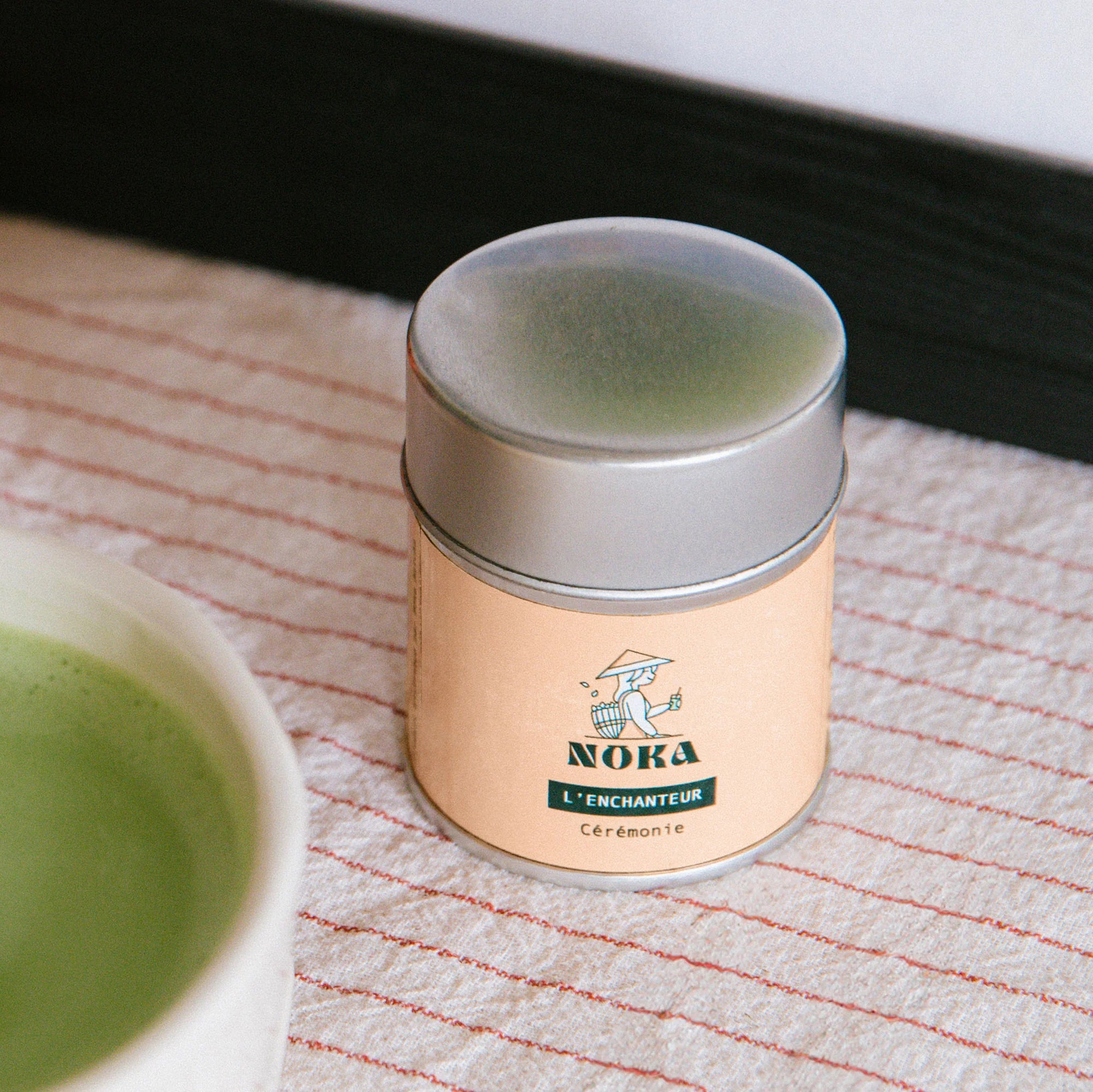
We ourselves use the word ceremonial to describe our matchas suited to plain consumption, and it remains a useful reference point for finding your way around. But since it isn't governed by any standard, we prefer not to stop there: each of our 4 matchas also states its precise geographic origin and the cultivar(s) used, so you can verify what's actually behind the word.
This information is complemented by independent lab analyses, available for all 4 of our matchas. It's this kind of document, not a word like ceremonial, that lets you verify what you're actually buying.
FAQ
In summary
Neither the word matcha nor the word ceremonial is a protected term in most countries. The former benefits from a technical definition (ISO, Japanese standard) that isn't systematically verified outside Japan, and the latter, while useful as a reference point, has no official definition anywhere. Even the new "Japanese Tea" geographical indication, registered by Japan in July 2026, protects geographic origin, not these two words. That doesn't make these words useless, but they aren't enough on their own: the most reliable way to judge a matcha is still to look at its harvest, its origin, its cultivar(s), and the documents that accompany it, alongside the label that describes it.
Any questions about the origin or composition of one of our matchas? Contact us, we'll be happy to answer.