How Can You Tell If Matcha Is Poor Quality? 5 Surefire Signs
A good matcha can be recognized before the very first sip. The color, the texture of the powder, the way it whisks, all of it gives clues about its real quality, well before the taste. Here are the signs that actually matter, and why a word like ceremonial or single cultivar on the label is never enough on its own.
Color, a first clue
A good matcha shows a bright, luminous, almost vivid green. If it leans toward yellow or brown, there are two possible explanations: raw material that was already less high-quality to begin with, or a matcha that has oxidized over time, often due to poor storage. We cover the right habits for avoiding this oxidation in our article on storing matcha.
That said, watch out for the opposite extreme too: an extremely uniform, almost fluorescent green can, conversely, be hiding an added dye or artificial chlorophyll rather than genuine leaf quality. This is exactly why color alone is never enough to judge a matcha, it always needs to be confirmed by texture and taste.

On the left, a bright green matcha. On the right, a dull, yellow or brown matcha.
Texture, a real test at home
Even before tasting it, a good matcha can be judged by the texture of its powder: it should be extremely fine, almost like talc, and slip between your fingers without any perceptible grain. This fineness isn't just a cosmetic detail, it's very easy to check for yourself at home, when you prepare it.
If your matcha clumps up when whisked, if it stays difficult to mix, or if you need to blend it for a long time to get a smooth result, that's a real sign of poor quality. A properly ground and sifted matcha dissolves within seconds of whisking, with no particular effort. Lumps that resist often point to a powder that's less finely ground, sometimes the result of less careful drying or sifting.
Another telling sign: if you systematically have to sift your matcha yourself before whisking it to avoid lumps, that simply means the powder isn't fine enough to begin with. A truly well-ground matcha needs no extra step to whisk up without lumps, no matter who's preparing it. This is actually a real strength of our Noka matchas: they're ground fine enough to whisk directly, without ever needing to be sifted beforehand.
Taste, the test that doesn't lie
A good matcha has a naturally smooth, round, slightly umami taste, with no excessive bitterness to mask. No need to add sugar or a lot of milk to make it enjoyable: the balance is already there.
This is a point worth clarifying: a gritty or floury taste in the mouth, even on a matcha labeled as ceremonial or single cultivar, is still a sign of poor quality. These two words describe a category or a composition, not a guaranteed level of refinement: we explain why the word ceremonial isn't governed by any official standard, and why a single cultivar isn't automatically better than a good blend. In both cases, it's the raw material and the producer's know-how that determine the actual mouthfeel, not the label.
Origin, one clue among others
Today, the most reputable matchas come from Japan, from regions like Kagoshima or Uji. This isn't an absolute guarantee on its own, but it's a clue that counts, especially combined with the others. We detail the origin and cultivar(s) of each of our matchas in our article on the subject.
The foam, proof through preparation
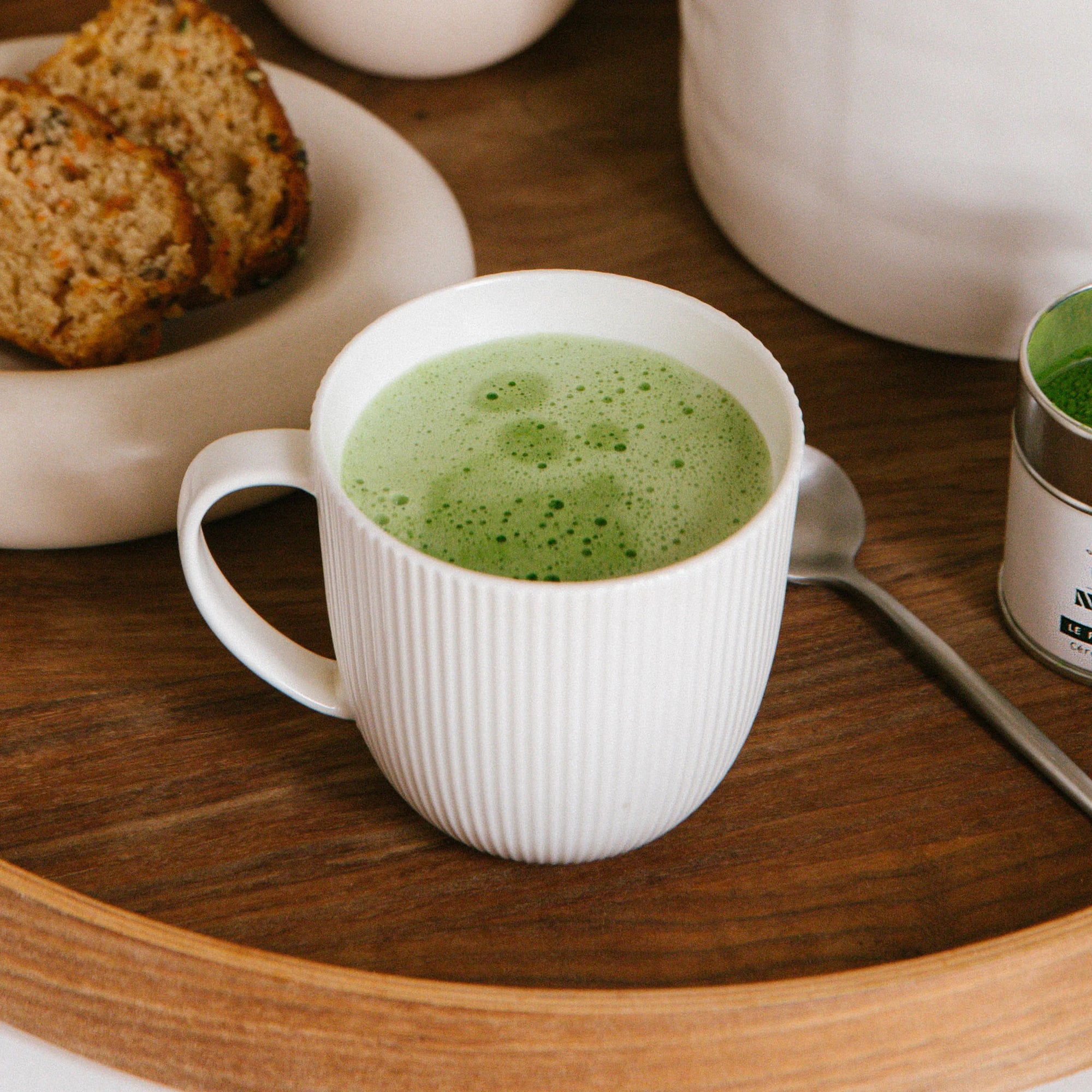
Well prepared, a good matcha forms a fine, dense, velvety foam on the surface, almost like a little cloud. This foam depends both on the quality of the matcha and on the preparation technique: good whisking with a chasen contributes as much as a well-ground powder. If the foam stays sparse or coarse despite vigorous whisking, the powder itself is often the culprit.

A fine, dense, velvety foam, made here with our Le Prestigieux matcha.
In summary
Color, texture, taste, origin, and foam together form a simple but reliable test. A bright green, a fine powder that whisks without lumps, a smooth and round taste, a velvety foam: that's what sets a good matcha apart. And above all, no word on the label, neither ceremonial nor single cultivar, replaces these concrete clues.
Have a question about your matcha's quality? Feel free to contact us, we'll be happy to answer.